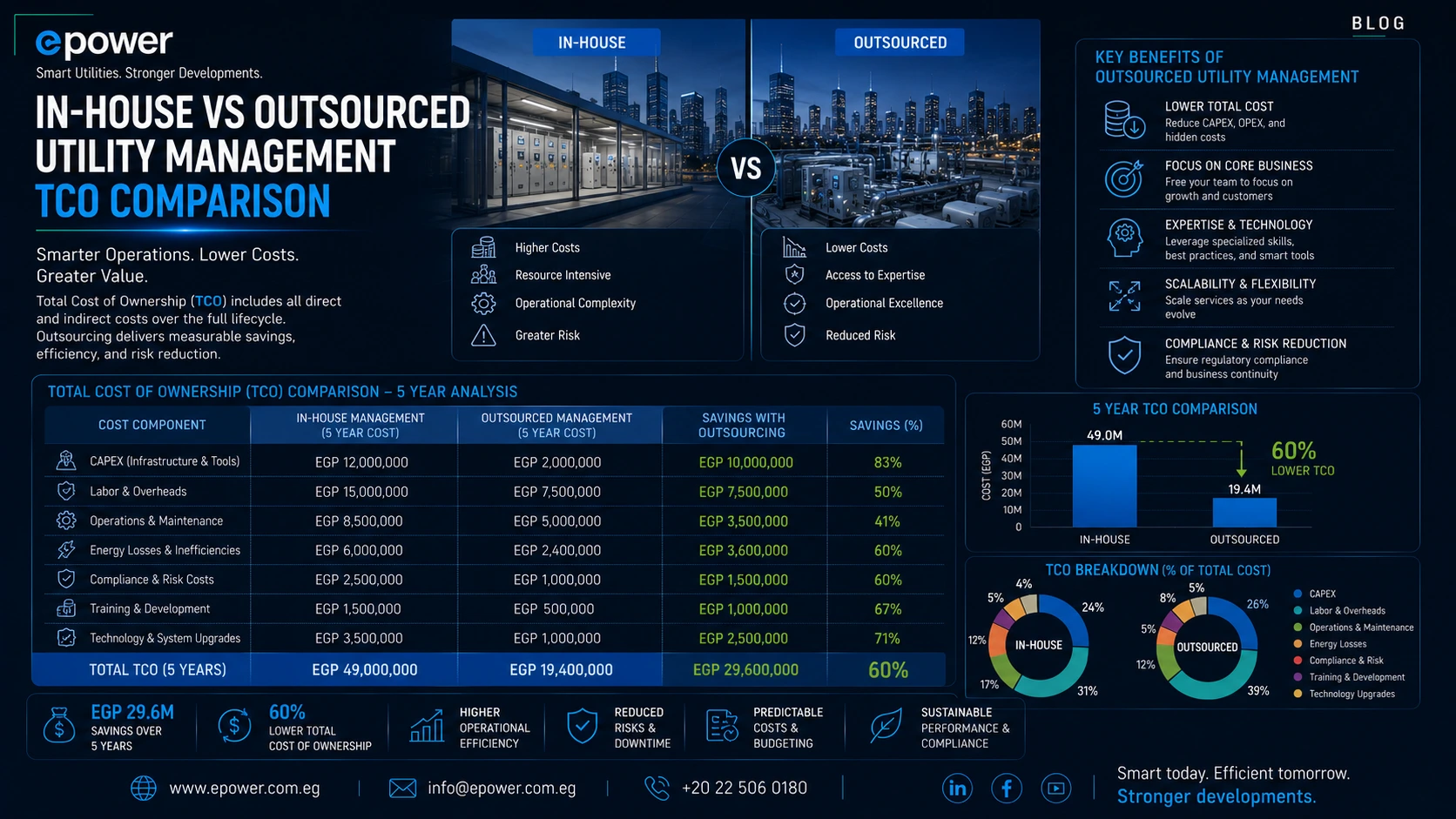
For real estate developers, residential compounds, commercial centers, industrial parks, and mixed-use developments, utility management is a long-term operational responsibility rather than a simple maintenance function. Electricity, water, wastewater, energy monitoring, metering, and utility infrastructure all generate recurring costs that can significantly affect the project's profitability.
When comparing In-House vs Outsourced Utility Management TCO, looking only at salaries or the monthly outsourcing fee can lead to the wrong decision. Total Cost of Ownership (TCO) should include direct labor, technology, training, equipment, management overhead, maintenance, emergency response, energy performance, and the cost of operational risks.
A proper TCO analysis therefore compares the complete lifecycle cost and value of both operating models.
What Does Utility Management TCO Mean?
Definition of Total Cost of Ownership
Total Cost of Ownership measures the complete cost of owning and operating a service or asset over a defined period.
For utility management, TCO goes beyond the visible operating budget and considers costs associated with:
- Personnel
- Equipment
- Technology
- Training
- Maintenance
- Management
- Software
- Emergency response
- Compliance
- Energy efficiency
- Asset performance
- Operational risks
This approach is particularly important because facility and utility operations represent significant recurring expenditures. IFMA recommends examining facility costs through a broader total-cost perspective rather than evaluating individual expenses in isolation.
What is In-House Utility Management?
How the In-House Model Works
With an in-house model, the developer or property owner creates its own utility management team and assumes direct responsibility for operating and maintaining the infrastructure.
The organization may employ:
- Utility managers
- Electrical engineers
- Mechanical engineers
- Technicians
- Metering specialists
- Supervisors
- Administrative staff
- Procurement personnel
The company also owns or manages the technology, tools, spare parts, monitoring systems, and operational processes required to deliver the service.
Advantages of In-House Management
Direct Control
The owner maintains direct control over employees, procedures, maintenance schedules, and operational decisions.
Internal Knowledge
An experienced internal team can develop detailed knowledge of the project's infrastructure and operational requirements.
Dedicated Resources
Large developments with significant and predictable utility workloads may benefit from having dedicated personnel permanently available on-site.
What is Outsourced Utility Management?
How the Outsourced Model Works
With outsourced utility management, a specialized service provider assumes responsibility for defined utility operations under a contractual agreement.
Depending on the scope, the provider may manage:
- Electrical distribution
- Water networks
- Wastewater
- Smart metering
- Utility billing
- Preventive maintenance
- Energy management
- Emergency response
- Asset management
- Utility monitoring
The contract can be structured around defined SLAs, KPIs, service levels, and performance requirements.
IFMA notes that outsourcing can provide access to specialized expertise and economies of scale while reducing internal overhead and allowing organizations to focus on their core activities.
In-House vs Outsourced Utility Management TCO Comparison
TCO FactorIn-HouseOutsourcedSalariesDirect costIncluded in service modelRecruitmentOwner responsibilityProvider responsibilityTrainingOwner responsibilityUsually provider responsibilityTechnologyCapital/operating costOften included or sharedManagement OverheadHigherLowerSpecialist ExpertiseRequires internal hiringAvailable through provider24/7 CoverageRequires additional staffingEasier to structure contractuallyScalabilityRequires hiringUsually more flexibleMaintenanceInternally managedProvider managedCost PredictabilityVariableCan be more predictableOperational ControlHigherManaged through contract/KPIsVendor ManagementOwner responsibilityConsolidated
The comparison shows why the lowest visible price does not necessarily represent the lowest TCO.
Hidden Costs of In-House Utility Management
Recruitment and Employee Costs
The real cost of an employee includes more than the basic salary. Recruitment, benefits, overtime, leave coverage, training, replacement, and management time can all increase the effective labor cost.
Technology Investment
A professional utility operation may require:
- CMMS platforms
- SCADA systems
- Smart metering platforms
- Energy monitoring
- Communication infrastructure
- Diagnostic equipment
These systems require initial investment, licensing, upgrades, and technical support.
Specialist Training
Utility infrastructure changes continuously. Internal teams must stay current with equipment, safety procedures, software, regulations, and maintenance technologies.
Emergency Coverage
Providing 24/7 coverage internally may require additional shifts, overtime, standby teams, and backup personnel.
Management Overhead
The owner must also manage recruitment, procurement, performance reviews, training, spare parts, subcontractors, and operational reporting.
Hidden Costs of Outsourced Utility Management
Outsourcing also has costs that must be carefully evaluated.
Contract Management
The owner needs appropriate resources to monitor the provider, review KPIs, validate invoices, and manage the contractual relationship.
Scope Exclusions
A low-cost contract may exclude emergency works, replacement parts, major repairs, specialist testing, or capital projects.
Provider Dependency
Poorly structured contracts can create excessive dependency on a service provider.
Transition Costs
Moving from an internal operation to an outsourced model may require asset audits, documentation, system integration, training, and operational handover.
For this reason, outsourcing should be evaluated based on the full contracted scope and lifecycle cost, not simply the quoted monthly fee.
How Outsourcing Can Improve TCO
Economies of Scale
Specialized providers can spread engineering resources, technical expertise, software, procurement capabilities, and management infrastructure across multiple projects. IFMA identifies economies of scale and reduced overhead among potential benefits of outsourcing facility services.
Access to Specialized Expertise
Instead of hiring separate specialists for every technical discipline, the developer can access a multidisciplinary team through one provider.
Better Preventive Maintenance
A structured preventive maintenance program reduces equipment failures and emergency interventions. The U.S. Department of Energy identifies effective operations and maintenance as one of the most cost-effective ways to improve equipment longevity, reliability, safety, and energy efficiency.
Improved Energy Performance
Professional monitoring can identify abnormal consumption, inefficient equipment, peak-demand issues, and opportunities for optimization.
Flexible Staffing
Outsourcing allows resources to scale according to project size and operational demand without requiring the developer to continuously recruit additional employees.
How to Calculate Utility Management TCO
In-House TCO Formula
A practical model can be structured as:
In-House TCO = Labor + Benefits + Recruitment + Training + Technology + Equipment + Maintenance + Management Overhead + Emergency Costs + Energy Inefficiency Costs
Outsourced TCO Formula
Outsourced TCO = Contract Fees + Contract Management + Excluded Services + Transition Costs + Additional Works + Technology Costs
The comparison should ideally cover a multi-year period rather than a single financial year.
Include Performance in the Calculation
Cost alone is not enough. The analysis should also compare:
- System uptime
- Response time
- Energy consumption
- Maintenance backlog
- Equipment failures
- Customer complaints
- Compliance
- Asset lifespan
- Utility losses
This creates a more accurate value-based TCO analysis.
When is In-House Utility Management Better?
Large and Highly Specialized Operations
A very large facility with continuous and predictable utility requirements may justify a dedicated internal team.
Strong Existing Expertise
Organizations that already have experienced engineering and facility teams may find that internal management provides strong value.
High Need for Direct Control
Some critical environments may require direct internal control over operational decisions and personnel.
When is Outsourced Utility Management Better?
Real Estate Developers
Developers can focus on property development, leasing, sales, and investment while specialized teams manage utility operations.
Multi-Phase Developments
Outsourcing can scale as new phases, buildings, and infrastructure are added.
Limited Internal Expertise
Projects without established utility management teams can immediately access specialized engineering resources.
Cost Optimization
Organizations seeking to reduce overhead and improve operational efficiency may benefit from an outsourced model. IFMA's integrated facility management research specifically highlights consolidation, cost control, and reduced management complexity as potential benefits of integrated outsourcing.
Why Choose epower?
epower provides integrated utility management solutions designed to help real estate developers, residential communities, commercial developments, industrial facilities, and mixed-use projects optimize their total cost of ownership.
By combining electrical infrastructure expertise, smart metering, preventive maintenance, energy management, utility monitoring, and technical operations, epower can provide an integrated alternative to maintaining multiple specialized internal resources.
The objective is not simply to outsource manpower. Instead, epower focuses on improving utility performance, reducing avoidable operational costs, protecting infrastructure assets, and providing measurable service through defined operational requirements and performance indicators.
Conclusion
The decision between In-House vs Outsourced Utility Management TCO should never be based solely on salaries versus outsourcing fees. A reliable comparison must consider the complete lifecycle cost of people, technology, maintenance, management, energy performance, emergency response, and operational risk.
In-house management provides control and direct ownership of resources, while outsourcing can provide specialized expertise, scalability, economies of scale, and lower management complexity.
For many real estate developers and large developments, the strongest approach is to evaluate both models using a multi-year TCO framework and measurable operational KPIs. The right choice is ultimately the model that delivers the best combination of cost, reliability, efficiency, scalability, and long-term asset performance.
Frequently Asked Questions
What is TCO in utility management?
TCO, or Total Cost of Ownership, measures the complete lifecycle cost of managing utility operations, including labor, technology, maintenance, management, energy performance, and operational risks.
Is outsourced utility management always cheaper?
No. Outsourcing is not automatically cheaper. Its value depends on project scale, service scope, staffing requirements, technology needs, and the provider's ability to deliver measurable operational efficiencies.
What are the biggest hidden costs of in-house utility management?
Common hidden costs include recruitment, employee benefits, overtime, training, technology, software, spare parts, management overhead, emergency coverage, and specialist contractors.
What should be included in an outsourcing contract?
The contract should clearly define services, exclusions, SLAs, KPIs, response times, preventive maintenance requirements, reporting, emergency services, spare parts, performance standards, and pricing mechanisms.
How can outsourcing reduce utility TCO?
Outsourcing can reduce TCO through economies of scale, specialized expertise, preventive maintenance, optimized staffing, centralized technology, and improved energy and asset performance.
Which model is better for real estate developers?
There is no universal answer. Developers should compare both models over a multi-year period and evaluate total cost alongside reliability, scalability, asset performance, energy efficiency, and service quality.
Why choose epower for outsourced utility management?
epower combines utility management, electrical infrastructure, smart metering, preventive maintenance, and energy optimization to help developers control operational costs while improving the reliability and long-term performance of their utility infrastructure.